
4 ways to put productivity on the leadership agenda


Improving productivity outcomes isn’t about working harder. It’s about rethinking management, skills and how HR leaders measure and influence performance, says the Deputy President of the Productivity Commission.

For the first time in decades, economists are warning that future generations could experience lower living standards than today. 

For HR leaders, this is not an abstract concern. With 80 per cent of GDP now generated by services – industries where people are the service – the way workplaces are organised, managed and developed is central to lifting productivity.

Speaking to HRM in October, Alex Robson, Deputy Chair of the Productivity Commission, said the factors that will meaningfully lift productivity levels are often misunderstood.

“It’s not about working harder or working longer. It’s about working smarter,” he said. “For example, in 1901, it cost the average Australian worker 473 hours of work to afford a bicycle. Today it costs just six hours. That’s an 8,000 per cent increase in productivity – and it didn’t come about because we’re working 8,000 per cent harder.

“Simply working harder is not a recipe for long-run increases in living standards. You can only squeeze so much juice out of the lemon.”

Lasting productivity gains, he said, come from better technology implementation and uptake, smarter management practices, investment in skills and an openness to change.

Rethinking productivity in a tougher economic era

Australia enjoyed decades of productivity growth following the sweeping reforms of the 1980s and 1990s. But those levers – such as floating the dollar and opening trade and investment with other countries – can only be pulled once, said Robson..

“Today it’s a game of inches rather than feet or yards.”

The challenge is that Australia’s historical competitiveness rates have been steadily declining, save for a temporary spike in 2024 (see graph below).
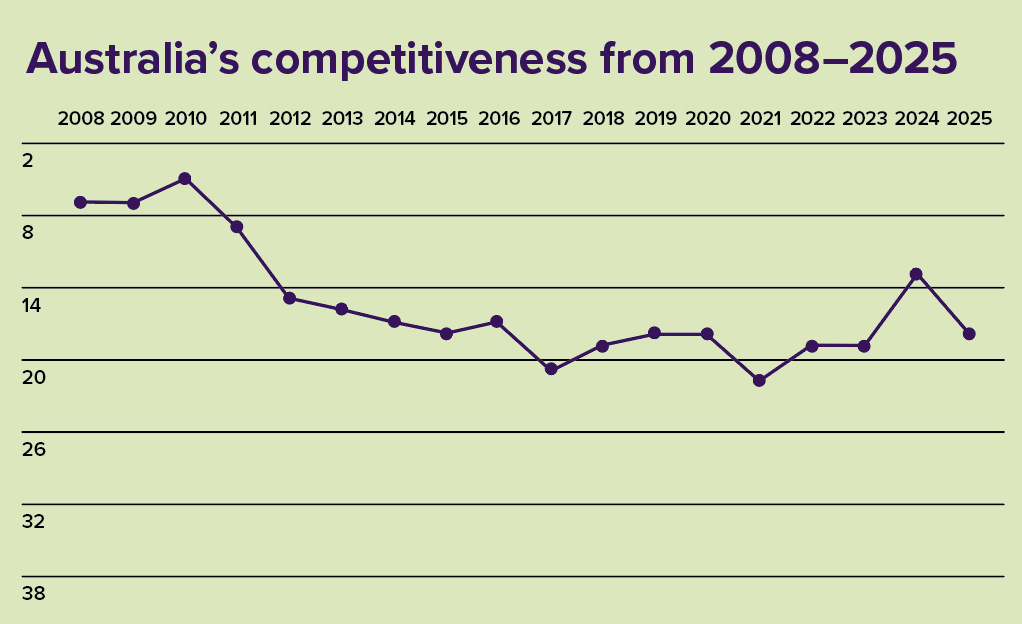
Source: CEDA, IMD World Competitiveness Yearbook, 2025.

This decline is due to a combination of slow economic growth and a dip in overall business efficiency, according to the Committee for Economic Development of Australia (CEDA).

Robson argues that productivity growth isn’t something governments impose ‘on’ business; it is generated within firms by their people, with the government shaping the conditions for success. The impact comes when leaders – particularly HR executives – embed strong people management practices that enable workforces to perform at their best.

Evidence from AHRI’s research into high-performance work systems shows that HR practices such as flexible work and strong learning and development not only lift engagement, but also deliver financial performance above industry averages.

Beyond these practices, Robson sees two main levers to move the needle:

1. Identifying and removing barriers

“If there are barriers – whether regulatory or structural – that’s what needs to be addressed.”

2. Embedding a growth mindset

HR directors should bring a “northern star” vision to the executive table, he said.

“Too often growth and dynamism are absent from conversations. Without it, the risk is our kids could have a lower standard of living than us.”

Closing Australia’s innovation gap

One of the Productivity Commission’s most concerning findings is that 98 per cent of Australian businesses are not engaged in “new-to-world” innovation. Instead, they rely on adapting existing ideas – a process known as diffusion.

“The problem is many firms don’t even know where the frontier is in their industry, let alone how to get there,” said Robson.

“This means businesses are often innovating in the dark, uncertain of whether they are investing in version 2.0, 3.0 or 4.0 of a rapidly evolving technology such as AI.”

If the majority of firms adopt new practices only after competitors abroad have already established a lead, this results in economic risks and stagnation. 

In addition, employees miss opportunities to develop the adaptive skills that come with early experimentation and change. Bridging this innovation gap requires coordinated action. 

Robson said industry associations can help define and share sectoral frontiers; universities can act as partners in applied research and knowledge transfer; and HR leaders, by connecting external insights to internal capability-building, can ensure their organisations are not left behind. 

“That is where effective management practices come in – helping organisations recognise and overcome those barriers.”

“Simply working harder is not a recipe for long-run increases in living standards. You can only squeeze so much juice out of the lemon.” – Alex Robson, Deputy Chair, Productivity Commission

Four ways to bring productivity back into focus

For HR leaders seeking to elevate productivity on the agenda, Robson advises starting with these four areas:

1. Understand the ‘why’ 

“The first step is to understand how [AI or new practices] are being used, why they’re being used and what the growth case is for them.”

2. Coach for experimentation 

Embedding dynamism means encouraging experimentation, fostering skills development and ensuring that management practices are designed to anticipate change rather than merely respond to it. 

“Productivity growth isn’t like yeast, where everyone rises evenly. It’s like mushrooms – patches emerge where experimentation works, and others learn from it.”

3. Enhance management capabilities

Next, the priority becomes management capability. For HR leaders, this translates into sustained investment in frontline and middle managers who can design work to be smarter, not harder.

“We put forward a recommendation in our report on the skilled and adaptable workforce around the government having a role to play in providing advisory services in relation to on-the-job training. That could be on-the-job training of managers focusing on [management capability].”

4. Arm yourself with evidence

Finally, boards and executives expect evidence. Robson suggests HR leaders build reporting mechanisms that link initiatives such as skills investment or flexible work directly to outcomes that resonate at the top table. 

“You need to design metrics that capture whether these tools are trusted, whether they improve quality of service and whether they enhance the consumer or employee experience.”

Together, these imperatives offer HR leaders both a vision and a practical roadmap – one that reframes productivity not as solely a government-led exercise, but as a core leadership responsibility, embedded in daily people management.

HR’s perspective on productivity levers

HRM also posed the question of how to raise Australia’s productivity levels to some of its members. Here’s what they had to say:

Matthew Connell FCPHR, General Manager of People and Culture, AHRI

Conversations about productivity are gravitating towards technology and AI in the workplace. 

While most people recognise AI as a great opportunity, we must also acknowledge people’s concerns. These can and most likely will impact engagement rates. Some employees are fearful of what AI might mean for their job security, so may not engage with it in a way that is enabling greater productivity.

HR needs to be drawn into conversations about the human impact in relation to gains in productivity through technology, and we need to be prepared to advise leaders on this.

For example, automating unhappy workers will not address one of the most important aspects of our roles in HR, which is to ensure we are providing a great employee experience and maintaining a solid employee value proposition – both of which aid better performance and therefore productivity.

While HR must support and lead organisational enablement, there’ll be times where we need to be prepared to bring an “is it worth it?” perspective to conversations with boards and executive teams to ensure the ROI of increased productivity doesn’t come at the expense of an organisation’s culture.

Rashmi Dixit Sharma CPHR, COO, Forward Ability Support, and CPO, Forward Ability Support & BrightSky Australia

Productivity is often thought of as doing more with less. However, what truly matters in a workplace is building a culture where people consistently give their best without feeling burnt out or disengaged.

While AI and working from home are the common debates, the more important factors impacting productivity are trust, psychological safety and agency. In other words, productivity is a no-brainer when people are trusted, valued and feel safe.

We experience the workplace through interactions with our manager, team, customers and peers. Leaders with high emotional intelligence read the room and tailor their response to the circumstances. They help teams prioritise and focus on solutions.

As HR professionals, it is important that we build leadership calibre to lead change collaboratively and to build trust in their teams.

Good HR practice requires honesty about the culture we actually foster, not just the culture we aspire to. Culture is the true catalyst for both productivity and change.

Andrew Marshall CPHR, AHRI ACT Vice President, Membership

One of the temptations for HR professionals, including myself, is to always be on the search for innovation. 

While there is a place for that in the productivity conversation – whether it be hypothesising on the impact of AI or introducing a four-day working week – I think we lose sight of some of the basic principles of productivity, such as getting the most out of employees through clear and consistent management. We get distracted with developing great leaders and forget to develop good managers too.

When COVID hit, most people didn’t know how to manage a remote workforce. This led to a real reliance on HR to offer advice and support, and, at times, almost take on that management responsibility. Organisations struggled with manager paralysis – in the absence of knowing what to do, nothing was done.

In some instances, this has carried over into work today. Instead of dealing with performance issues, for example, some managers defer to HR or avoid the issue altogether.

To help increase productivity, we need to embolden and empower managers to have frank conversations, set expectations and manage accordingly.

Celin Lam CPHR, Head of People and Culture, Eightcap

I’ve always believed HR’s greatest impact on productivity comes from getting the foundations right. Productivity declines when employees don’t have clarity around what’s expected, or when managers aren’t confident in leading their teams. Without that, even the most exciting initiatives will fail to have an impact.

The fundamentals are where HR can make the biggest difference, such as building competency frameworks so people know what skills matter, building solid performance processes that guide accountability, ensuring pay and benchmarking practices are transparent and fair, and equipping managers with the confidence to have open and constructive conversations. 

These all give employees clarity and trust, while also enabling managers to focus on setting direction and removing barriers.

By investing in management capability and aligning structures with business priorities, we create workplaces where people feel supported, accountable and connected to outcomes.

Sustainable productivity doesn’t come from working harder or longer. It comes from providing the frameworks, skills and trust that allow people to channel their energy into what really matters.

A version of this article was originally published in the October/November edition of HRM Magazine.


Join AHRI’s webinar on 2 December to explore what Australia’s changing workforce means for your organisation, and hear directly from experts unpacking the latest data on AI, absence and productivity.


Subscribe to receive comments
Notify me of
guest

0 Comments
Inline Feedbacks
View all comments
More on HRM

4 ways to put productivity on the leadership agenda


Improving productivity outcomes isn’t about working harder. It’s about rethinking management, skills and how HR leaders measure and influence performance, says the Deputy President of the Productivity Commission.

For the first time in decades, economists are warning that future generations could experience lower living standards than today. 

For HR leaders, this is not an abstract concern. With 80 per cent of GDP now generated by services – industries where people are the service – the way workplaces are organised, managed and developed is central to lifting productivity.

Speaking to HRM in October, Alex Robson, Deputy Chair of the Productivity Commission, said the factors that will meaningfully lift productivity levels are often misunderstood.

“It’s not about working harder or working longer. It’s about working smarter,” he said. “For example, in 1901, it cost the average Australian worker 473 hours of work to afford a bicycle. Today it costs just six hours. That’s an 8,000 per cent increase in productivity – and it didn’t come about because we’re working 8,000 per cent harder.

“Simply working harder is not a recipe for long-run increases in living standards. You can only squeeze so much juice out of the lemon.”

Lasting productivity gains, he said, come from better technology implementation and uptake, smarter management practices, investment in skills and an openness to change.

Rethinking productivity in a tougher economic era

Australia enjoyed decades of productivity growth following the sweeping reforms of the 1980s and 1990s. But those levers – such as floating the dollar and opening trade and investment with other countries – can only be pulled once, said Robson..

“Today it’s a game of inches rather than feet or yards.”

The challenge is that Australia’s historical competitiveness rates have been steadily declining, save for a temporary spike in 2024 (see graph below).

Source: CEDA, IMD World Competitiveness Yearbook, 2025.

This decline is due to a combination of slow economic growth and a dip in overall business efficiency, according to the Committee for Economic Development of Australia (CEDA).

Robson argues that productivity growth isn’t something governments impose ‘on’ business; it is generated within firms by their people, with the government shaping the conditions for success. The impact comes when leaders – particularly HR executives – embed strong people management practices that enable workforces to perform at their best.

Evidence from AHRI’s research into high-performance work systems shows that HR practices such as flexible work and strong learning and development not only lift engagement, but also deliver financial performance above industry averages.

Beyond these practices, Robson sees two main levers to move the needle:

1. Identifying and removing barriers

“If there are barriers – whether regulatory or structural – that’s what needs to be addressed.”

2. Embedding a growth mindset

HR directors should bring a “northern star” vision to the executive table, he said.

“Too often growth and dynamism are absent from conversations. Without it, the risk is our kids could have a lower standard of living than us.”

Closing Australia’s innovation gap

One of the Productivity Commission’s most concerning findings is that 98 per cent of Australian businesses are not engaged in “new-to-world” innovation. Instead, they rely on adapting existing ideas – a process known as diffusion.

“The problem is many firms don’t even know where the frontier is in their industry, let alone how to get there,” said Robson.

“This means businesses are often innovating in the dark, uncertain of whether they are investing in version 2.0, 3.0 or 4.0 of a rapidly evolving technology such as AI.”

If the majority of firms adopt new practices only after competitors abroad have already established a lead, this results in economic risks and stagnation. 

In addition, employees miss opportunities to develop the adaptive skills that come with early experimentation and change. Bridging this innovation gap requires coordinated action. 

Robson said industry associations can help define and share sectoral frontiers; universities can act as partners in applied research and knowledge transfer; and HR leaders, by connecting external insights to internal capability-building, can ensure their organisations are not left behind. 

“That is where effective management practices come in – helping organisations recognise and overcome those barriers.”

“Simply working harder is not a recipe for long-run increases in living standards. You can only squeeze so much juice out of the lemon.” – Alex Robson, Deputy Chair, Productivity Commission

Four ways to bring productivity back into focus

For HR leaders seeking to elevate productivity on the agenda, Robson advises starting with these four areas:

1. Understand the ‘why’ 

“The first step is to understand how [AI or new practices] are being used, why they’re being used and what the growth case is for them.”

2. Coach for experimentation 

Embedding dynamism means encouraging experimentation, fostering skills development and ensuring that management practices are designed to anticipate change rather than merely respond to it. 

“Productivity growth isn’t like yeast, where everyone rises evenly. It’s like mushrooms – patches emerge where experimentation works, and others learn from it.”

3. Enhance management capabilities

Next, the priority becomes management capability. For HR leaders, this translates into sustained investment in frontline and middle managers who can design work to be smarter, not harder.

“We put forward a recommendation in our report on the skilled and adaptable workforce around the government having a role to play in providing advisory services in relation to on-the-job training. That could be on-the-job training of managers focusing on [management capability].”

4. Arm yourself with evidence

Finally, boards and executives expect evidence. Robson suggests HR leaders build reporting mechanisms that link initiatives such as skills investment or flexible work directly to outcomes that resonate at the top table. 

“You need to design metrics that capture whether these tools are trusted, whether they improve quality of service and whether they enhance the consumer or employee experience.”

Together, these imperatives offer HR leaders both a vision and a practical roadmap – one that reframes productivity not as solely a government-led exercise, but as a core leadership responsibility, embedded in daily people management.

HR’s perspective on productivity levers

HRM also posed the question of how to raise Australia’s productivity levels to some of its members. Here’s what they had to say:

Matthew Connell FCPHR, General Manager of People and Culture, AHRI

Conversations about productivity are gravitating towards technology and AI in the workplace. 

While most people recognise AI as a great opportunity, we must also acknowledge people’s concerns. These can and most likely will impact engagement rates. Some employees are fearful of what AI might mean for their job security, so may not engage with it in a way that is enabling greater productivity.

HR needs to be drawn into conversations about the human impact in relation to gains in productivity through technology, and we need to be prepared to advise leaders on this.

For example, automating unhappy workers will not address one of the most important aspects of our roles in HR, which is to ensure we are providing a great employee experience and maintaining a solid employee value proposition – both of which aid better performance and therefore productivity.

While HR must support and lead organisational enablement, there’ll be times where we need to be prepared to bring an “is it worth it?” perspective to conversations with boards and executive teams to ensure the ROI of increased productivity doesn’t come at the expense of an organisation’s culture.

Rashmi Dixit Sharma CPHR, COO, Forward Ability Support, and CPO, Forward Ability Support & BrightSky Australia

Productivity is often thought of as doing more with less. However, what truly matters in a workplace is building a culture where people consistently give their best without feeling burnt out or disengaged.

While AI and working from home are the common debates, the more important factors impacting productivity are trust, psychological safety and agency. In other words, productivity is a no-brainer when people are trusted, valued and feel safe.

We experience the workplace through interactions with our manager, team, customers and peers. Leaders with high emotional intelligence read the room and tailor their response to the circumstances. They help teams prioritise and focus on solutions.

As HR professionals, it is important that we build leadership calibre to lead change collaboratively and to build trust in their teams.

Good HR practice requires honesty about the culture we actually foster, not just the culture we aspire to. Culture is the true catalyst for both productivity and change.

Andrew Marshall CPHR, AHRI ACT Vice President, Membership

One of the temptations for HR professionals, including myself, is to always be on the search for innovation. 

While there is a place for that in the productivity conversation – whether it be hypothesising on the impact of AI or introducing a four-day working week – I think we lose sight of some of the basic principles of productivity, such as getting the most out of employees through clear and consistent management. We get distracted with developing great leaders and forget to develop good managers too.

When COVID hit, most people didn’t know how to manage a remote workforce. This led to a real reliance on HR to offer advice and support, and, at times, almost take on that management responsibility. Organisations struggled with manager paralysis – in the absence of knowing what to do, nothing was done.

In some instances, this has carried over into work today. Instead of dealing with performance issues, for example, some managers defer to HR or avoid the issue altogether.

To help increase productivity, we need to embolden and empower managers to have frank conversations, set expectations and manage accordingly.

Celin Lam CPHR, Head of People and Culture, Eightcap

I’ve always believed HR’s greatest impact on productivity comes from getting the foundations right. Productivity declines when employees don’t have clarity around what’s expected, or when managers aren’t confident in leading their teams. Without that, even the most exciting initiatives will fail to have an impact.

The fundamentals are where HR can make the biggest difference, such as building competency frameworks so people know what skills matter, building solid performance processes that guide accountability, ensuring pay and benchmarking practices are transparent and fair, and equipping managers with the confidence to have open and constructive conversations. 

These all give employees clarity and trust, while also enabling managers to focus on setting direction and removing barriers.

By investing in management capability and aligning structures with business priorities, we create workplaces where people feel supported, accountable and connected to outcomes.

Sustainable productivity doesn’t come from working harder or longer. It comes from providing the frameworks, skills and trust that allow people to channel their energy into what really matters.

A version of this article was originally published in the October/November edition of HRM Magazine.


Join AHRI’s webinar on 2 December to explore what Australia’s changing workforce means for your organisation, and hear directly from experts unpacking the latest data on AI, absence and productivity.


Subscribe to receive comments
Notify me of
guest

0 Comments
Inline Feedbacks
View all comments
More on HRM